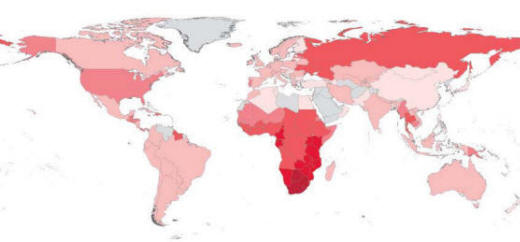
Global prevalence of HIV 2009
Grey: No data or <.1% .Light pink: 1% – <.5% .Darker Pink 5% – <1% Darkest pink/very light red: 1% – <5% Red: 5% – <15% >Darkest red15% – 28%
Source: UN AIDS Report 2010 Ch. 2 Epidemic http://www.unaids.org/documents/20101123_GlobalReport_Chap2_em.pdf

Map legend shows percentages of adult population.
Trends:
HIV/AIDS has emerged as a health and development crisis over the past decade. Since the first clinical evidence of AIDS was reported two decades ago, the disease has spread to every corner of the world. Still rapidly growing, the epidemic is reversing development gains, robbing millions of their health and lives, widening the gap between rich and poor, and undermining social and economic security.
The magnitude of the HIV/AIDS epidemic far exceeds the worst-case projections of 1990. Worldwide, the number of people living with HIV is 50 percent higher than projected. By the end of 2001, an estimated 40 million people were infected with HIV, with over 95 percent of those living in developing countries. Approximately 18.5 million people with HIV are women and 3 million are children under age 15.
Sub-Saharan Africa is devastated. By the end of 2001, an estimated 28.5 million Africans were living with HIV. The region bears over 70 percent of the world's young people infected with HIV and about 80 percent of the children orphaned by AIDS. In several countries in Southern Africa, at least one in five adults is HIV-positive. The disease is also spreading rapidly in parts of Asia, the Caribbean, and Eastern Europe. An estimated 700,000 people in South and Southeast Asia, and 140,000 people in Latin America and the Caribbean became infected in 2001.
From one region to the next, the major type of HIV transmission (i.e. sexual transmission, mother-to-child transmission, intravenous drug use) differs, thus affecting various groups within a population, and requiring multiple strategies to combat the epidemic. The Joint United Nations Programme on HIV/AIDS (UNAIDS), formed in 1996 and currently consisting of seven organizations (UNICEF, UNDP, UNFPA, UNESCO, WHO, the World Bank, and UNDCP), works to share information, plan and monitor coordinated action, and provide technical assistance and financing for HIV/AIDS prevention and care. In June, 2001, the United Nations Special Session on HIV/AIDS issued a Declaration of Commitment that outlines goals and strategies to reduce the impact of HIV/AIDS.
Source: www.childinfo.org
For more information on the facts about AIDS, for each country, link to UNAIDS at: www.who.int/emc-hiv/fact_sheets/index.html .
Back to Nutrition, Health, and Population Page Hunger Notes Home Page